Greetings from Colorado. I hope everyone is having a nice summer thus far. Being nearly 8,000 feet above sea level certainly comes with its challenges, but I’m having a nice time. I have learned, though, that hiking mountains is not my strong suit. Hiking trails? Now, we’re in business. Anyways, it’s great to be back on Substack, writing about what I love, and little phenomena in American politics that catch my attention.
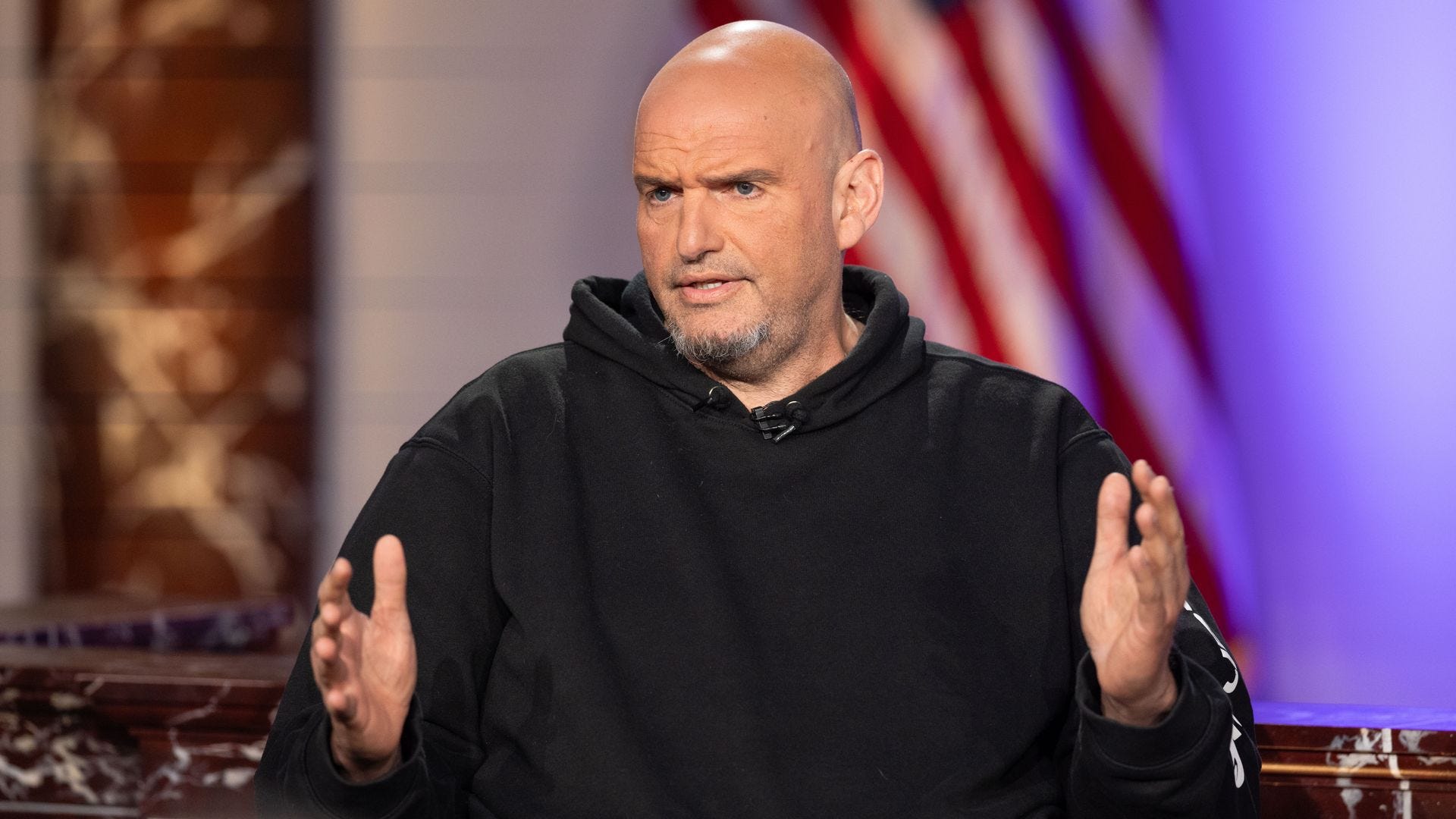
This morning, I read an excellent article by Molly Ball (might I add, one of the best-of-the-best congressional journalists out there) at the Wall Street Journal about Pennsylvania’s senior U.S. senator, John Fetterman. Of course, the whole article is good - but the one part that interested me most was Ball’s comments about Fetterman being absent for 30 votes that the Senate has taken this year. Per Ball: “Fetterman was hospitalized in 2023 for mental-health issues. He has missed 30 votes this year, the third most of any senator, according to a Wall Street Journal analysis of GovTrack data.”
Academics, in a certain sense, are sort of trained to read stuff and then spot potential “research questions” about which they could write and investigate later down the road. So this article will focus on U.S. senators who have missed high percentages of votes and track down reasons (if any) that these senators - or the media - have given for missing such votes. Fortunately for us, GovTrack has excellent “report cards” in which they track certain characteristics of legislators for each two-year period of Congress, including - you guessed it! - the number of votes they missed. Where we’ll have to do a little digging is the reasons for which they missed said votes.
For the purposes of this piece, we’ll investigate missed votes from the 117th (2021-22) and 118th (2023-24) Congresses. Of course, a more robust study would include all Congresses dating back to the beginning of GovTrack’s “Report Card” collections (or even beyond) - but for a Substack piece, focusing on two Congresses should be sufficient to paint a good picture behind the reasons for senators missing votes.
Expectations? Hypotheses?
Any good social science piece should try and guess why X (our unknown variable here) causes Y (in this case, senators missing votes). Ball’s article can provide us with a bit of a hypothesis: senators will miss votes due to hospitalizations. For a bit of context: Fetterman, after suffering from a stroke during his 2022 campaign for the U.S. Senate, fell into a deep depression shortly after being sworn in in January of 2023 and checked himself into Walter Reed Medical Center (just outside D.C.) to get treatment. So Ball’s comment leads us to believe that hospitalizations - of any kind - will lead senators to miss votes. And it is logical to think that older senators will be hospitalized more than their younger colleagues, though that won’t always be the case. In fact, in the 118th Congress, the median age of a U.S. senator was 65.3 years old, meaning that a full 50 percent of U.S. senators were over 65 years old. Certainly no spring chickens. But, more seriously, these senators are well past the prime of their life and are likely more susceptible to injury and hospitalization than their younger colleagues. All in all, Ball’s comments combined with logic of the human age might lead us to a hypothesis that the older the senator is - which increases a potentially higher rate of hospitalizations and time away from the chamber - the more likely they are to miss votes.
The data
Per GovTrack, here are the 10 (11, because of a tie at 10th place) senators who missed the most votes in the 117th Congress (2021-22):
Mike Rounds (R-SD), 21.7% absentia on votes
Richard Burr (R-NC), 13.9% absentia on votes
Kevin Cramer (R-ND), 12.9% absentia on votes
Dianne Feinstein (D-CA), 11.9% absentia on votes
Pat Toomey (R-PA), 11.1% absentia on votes
Jim Inhofe (R-OK), 10.6% absentia on votes
Jerry Moran (R-KS), 10.2% absentia on votes
John Barasso (R-WY), 10% absentia on votes
Bernie Sanders (I-VT), 9.4% absentia on votes
Roy Blunt (R-MO) & Lindsey Graham (R-SC), 8.7% absentia on votes
And here are the 10 senators who missed the most votes in the 118th Congress (2023-24), also per GovTrack:
Adam Schiff (D-CA), 47.8% absentia on votes
J.D. Vance (R-OH), 22.1% absentia on votes
Tim Scott (R-SC), 21.6% absentia on votes
John Fetterman (D-PA), 21.2% absentia on votes
John Barasso (R-WY), 16.8% absentia on votes
Joe Manchin (D-WV), 14.1% absentia on votes
Marco Rubio (R-FL), 12.8% absentia on votes
Mike Braun (R-IN) & Bill Hagerty (R-TN), 12.5% absentia on votes
Kevin Cramer (R-ND), 11.2% absentia on votes
Analyzing the data
Let’s begin with the 118th Congress and the exceptionally high absentia rate (nearly 50%!) for Adam Schiff, formerly a U.S. House representative from California. Such a rate of absentia is exceptionally high and likely has to do with factors beyond the legislator’s control. Schiff was elected in a special election to fill the seat of long-serving Dianne Feinstein, who passed away in the middle of the 118th Congress. Schiff took his Senate seat in 2024, meaning he missed all of the votes from 2023 - because he wasn’t yet a senator. That certainly explains why he missed nearly half the votes in the 118th Congress. And since his late election to the chamber was out of his control, I will not count it as a reason - or discovery - as to why senators missed high rates of votes.
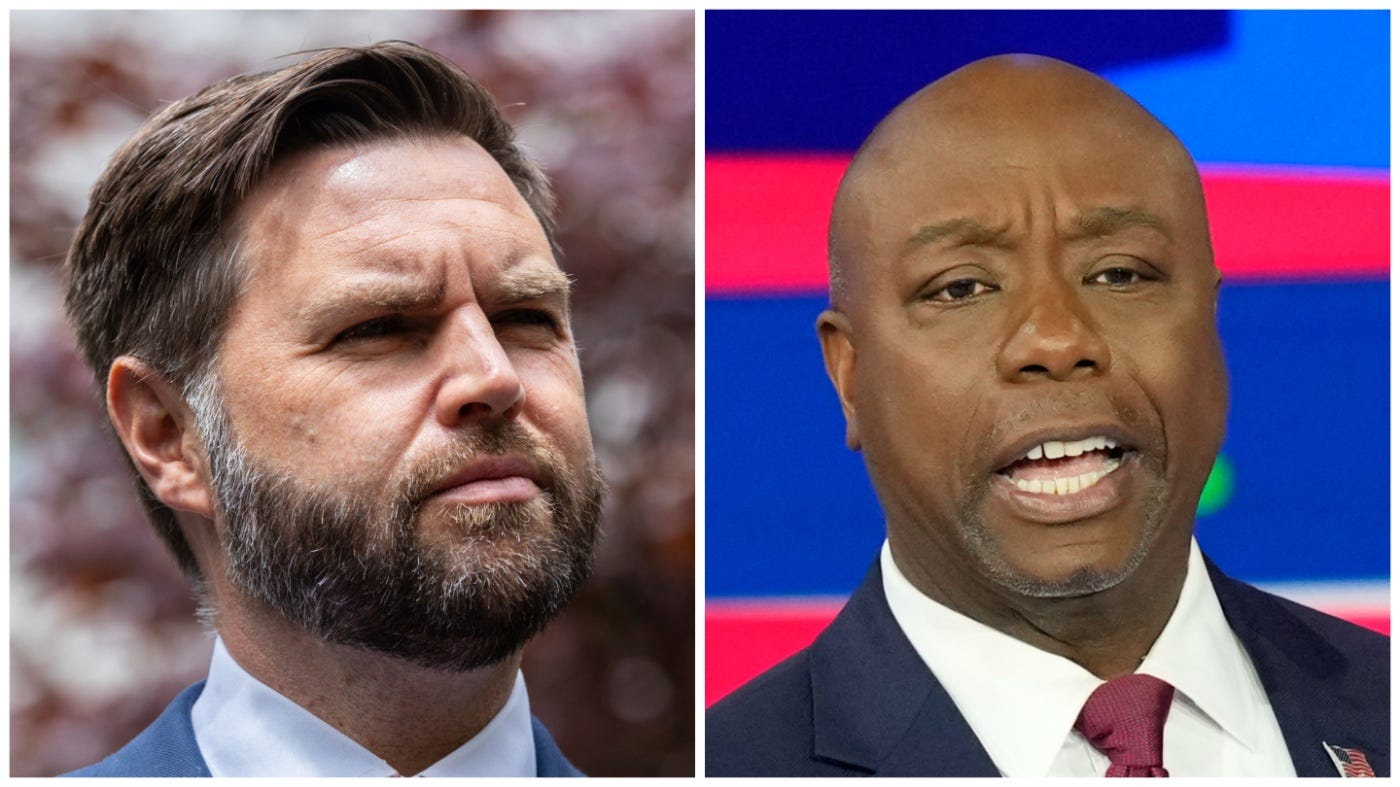
In the cases of J.D. Vance and Tim Scott, both became immersed in campaigning for the presidency (or vice presidency, in Vance’s case) during the 118th Congress. Scott was a presidential candidate for the 2024 Republican nomination from May to November of 2023. And Vance was tapped as Trump’s vice presidential pick at the Republican National Convention in July of 2024, hitting the campaign trail shortly thereafter as a newly-minted member of the Trump team. In both cases, campaigning for the presidency (or vice presidency!) likely explain these senators’ absentia on votes.
We can also take a look at exactly when Scott and Vance were missing votes in the U.S. Senate. If my claim is correct that they missed votes due to their time on the campaign trail, then we should expect to see higher levels of vote absentia during the periods in which they were campaigning. For Scott, that would be from May to November, 2023 - and for Vance, that would be from July to November of 2024 (and possibly even after, since he was elected vice president and knew his time in the Senate was running out). To examine this, I look at the U.S. Senate’s detailed record of roll-call voting and simply examine whether these Senators voted or not in my specified timeframe.
For Vance, the predictions bore out cleanly. Vance’s last vote (of the ones I examined) was on July 11, 2024. Trump picked Vance to be his VP just four days after that, on July 15. And while I didn’t examine every single vote between July 23, 2024 and the end of the session, Vance was consistently “not voting” from the multitude that I did examine. As I combed through the votes, it became clear that next to Vance’s name was a “not voting” label, so my hypothesis bores out.
For Scott, the pattern is more nuanced. Apart from a few votes in June of 2023, Scott was largely present - and voting! - on Senate business. So, while for Vance my hypothesis bores out, for Scott, it does not. Perhaps we can equate that to Vance actually being selected as the vice president on an official party ticket - and Scott running an uphill battle to unseat the highly-popular (within the Republican Party) Donald Trump, who would clinch his 3rd GOP nomination in July of 2024.
And now we have at least some support for our first reason to explain high absentia on votes - seeking higher office. An old political science adage is that every senator looks in the mirror and sees a future president. This finding is also consistent with a bevy of political science literature that explain why legislators often run for higher office - be it House representatives running for the Senate, or senators running for president.
For Fetterman, who ranks fourth on the list of missed votes in the 118th Congress, Ball provides support that this is due to his hospitalizations for depression, which lasted nearly six weeks, from mid-February to late March of 2023. Because the Senate during COVID, unlike the House, did not pass a motion to adopt proxy voting - that is, voting from home or a location other than the Senate floor - Fetterman missed all of the votes when he was hospitalized. Upon a quick first glance, Fetterman, in being absent from February 15 to March 31, 2023, would’ve missed nearly 60 votes, equating to 17% of all Senate votes in 2023. So, we can add personal injury and hospitalization as another reason for senators missing votes.
Is age at all a factor? That is, how did senators’ median age stack up with the median age of those who missed votes most frequently? In the 117th Congress, the median senator was 64.8 years old, while those who missed the most votes had a median age of 69.7 years old. So, in the 117th Congress, the average senator (those in the top 10 as having missed the most votes) were, on average, nearly 5 years older than a senator in the chamber at large. Yet, the trend seems to reverse in the 118th Congress. As Pew reports, in the 118th Congress, the median age of a senator was 65.3 years old (at the beginning of the Congress, in January 2023). Excluding Schiff (who was not yet a senator at the beginning of the 118th Congress), the median age for senators most in absentia on votes was 59.2 years old, a full six years younger than the median senator.
Back to the narrative of campaigning - it makes sense that senators will miss votes if they are out on the campaign trail. In the case of J.D. Vance, this was clear - Vance missed the vast majority of votes after he was selected as Trump’s VP. And what was Vance doing? Of course - campaigning.
So, the campaigning narrative begs the question - were these senators who missed lots of votes up for re-election at the end of that Congress? If so, it would be reasonable to believe that these senators would have to forego time in the chamber and hit the campaign trail, particularly if they come from a battleground state.
Analysis of the U.S. Senate’s website for both the Class III (elected in November 2022) and Class I (elected in November 2024) senators suggests meager support for that prediction. For Class II senators, the only senator up for re-election at the end of the 117th Congress was Jerry Moran of Kansas, which is a highly uncompetitive state that would likely not require much campaigning. For Class I senators, the only two senators up for re-election at the end of the 118th Congress were Kevin Cramer of North Dakota and Tim Scott of South Carolina, which are, again, uncompetitive states that would likely not require much campaigning. So clearly being up for re-election and needing to be on the campaign trail does not have a remarkably strong relationship in the case of missing votes, unless, of course, you are J.D. Vance (especially), Jerry Moran, Kevin Cramer, or Tim Scott. And, inevitably, other factors could be at play, too.
Limitations and final thoughts
Of course, there is more work to be done in order to explain why senators miss votes, some more frequently than others. A more robust study would have included further means to examine why senators are absent on votes more frequently than others. For example, perhaps major weather disasters in a senator’s state required them to be back home and miss several floor votes as a result. Maybe personal or family related matters played a role. For example, in September 2021, Dianne Feinstein (D-CA) returned home to San Francisco for a week to care for her husband while he was hospitalized. Maybe some senators don’t particularly care about how often they vote - or how their constituents view a lack of voting. And maybe some are just plain lazy or not willing to send a signal of support or opposition on a bill. (If you’re looking for a great book on the phenomenon of “party messaging votes” in Congress, Frances Lee’s Insecure Majorities is the best one out there).
But my hope is that this mini-study can give us some sense of why senators miss votes. It seems that campaigning and hospitalizations are both likely reasons. In the meantime, I’ll be eagerly awaiting GovTrack’s Report Cards for the 119th Congress (which sadly won’t be out until early 2027!), and I’ll be curious to see if my findings hold.